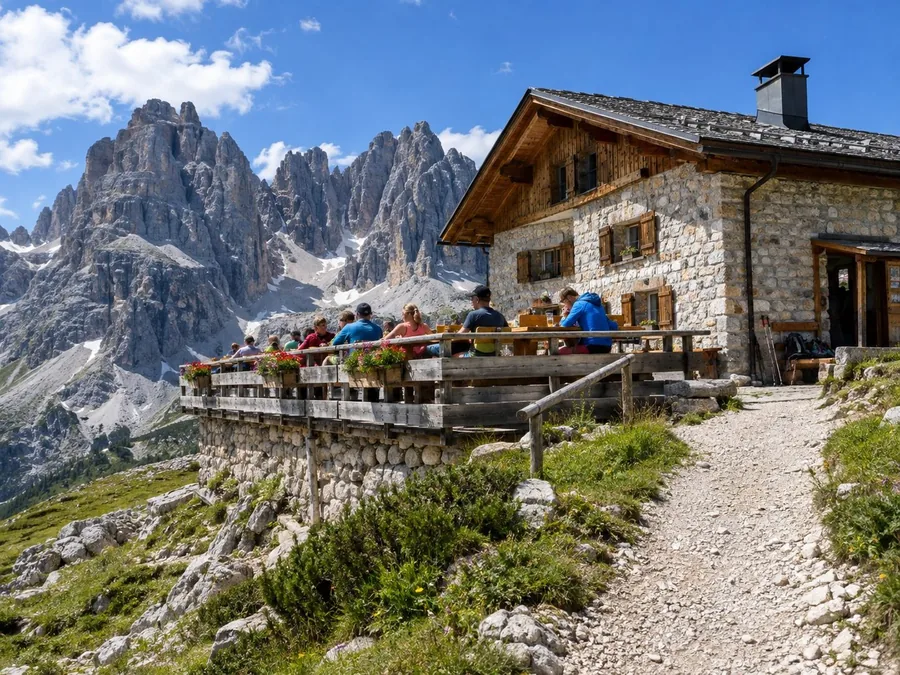
Hut to hut in the Dolomites
Guided hike or day trip?The famous trails are marked and walked by thousands of people without a guide. What GetYourGuide sells is either a local guide on one of those trails — the Tre Cime loop, Lake Sorapis, the Cinque Torri, the Alpe di Siusi — or a van or coach day from Venice or Lake Garda that shows you lakes and passes with short walks between.
Compare the optionsAlta Via 1 or Alta Via 2
The alte vie are numbered high routes that link huts across the range, and the first two are the ones people mean when they ask which multi-day trek is best. For almost everyone my answer is the Alta Via 1. It runs north to south, from Lago di Braies in South Tyrol to Belluno in the Veneto, and the main line needs no via ferrata kit; a few optional variants have cables, and you can leave them out. It crosses the Fanes and Lagazuoi country, passes the Cinque Torri and the Nuvolau, and further south reaches the Civetta and the Pelmo. I have walked the northern half in pieces over several summers, a few days at a time, and it is the route I send friends to first. The route facts are summarised in the Alta Via 1 entry on Wikipedia.
The Alta Via 2 asks a lot more. It goes from Bressanone/Brixen to Feltre, about 174 km by Cicerone’s count and about 180 km by some other guides, over 11 to 15 days. It crosses Puez-Odle, the Sella, the Marmolada and the Pale di San Martino on exposed ridges and scree, with several cabled and via ferrata sections, and it is meant for experienced hikers with a head for heights (Cicerone’s Alta Via 2 planning guide). If the CAI grades mean little to you yet, read how hard Dolomites hiking is before you choose.
| Alta Via 1 | Alta Via 2 | |
|---|---|---|
| From – to | Lago di Braies – Belluno | Bressanone – Feltre |
| Length | About 120 km | About 160–180 km |
| Days | 8–10, sometimes 11 | 11–15 |
| Cables | None on the main line | Several cabled and via ferrata sections |
| Suits | Fit hikers new to hut trips | Experienced, sure-footed hikers |
A realistic five days on the AV1
Five days is enough for the northern section, and it is the stretch I would pick for a first hut trip. You start at Lago di Braies, where the lake circuit is also the first stretch of the route, and walk south into the Fanes and Lagazuoi area. Passo Falzarego, at the foot of the Lagazuoi cable car, is the natural end of a three- or four-day version; with a fifth day you carry on past the Cinque Torri and the Nuvolau towards Passo Giau. The route crosses roads or lifts at Passo Falzarego, Passo Giau, the Cinque Torri and Passo Staulanza, which is what makes a short section practical: you can join or leave it at any of them.
I am not going to write you a stage table from a desk. In July the stages are decided by the beds you manage to book, and you walk the distance they set. What I can describe is the effort. The AV1 asks for several days in a row of about 5 to 7 hours on foot, with climbs of 800 to 1,000 m or more, carrying your pack. The Tre Cime loop has 300 to 400 m of climbing; a normal AV1 day has two or three times that, and you get up the next morning and do it again.
How booking a rifugio works
There is no central booking portal. Each hut takes bookings on its own, by email, phone, WhatsApp or a form on its website; the Dreizinnenhütte (Rifugio Locatelli) on the Tre Cime loop, for example, has an online form, and the Tre Cime huts page lists its 2026 opening up to 27 September. For the popular AV1 huts in July and August, book 3 to 5 months ahead. For late June and September, 1 to 3 months ahead often works. I book the hardest night first, the one where only one hut is within reach, and fit the others around it.
Almost everyone who sleeps in a hut takes half board (mezza pensione): dinner, a bed and breakfast. It costs noticeably less than a hotel room in the valley. Dorms are the cheapest beds and private rooms cost more, and drinks, packed lunches and showers are often charged on top. How a hut trip compares with other ways of doing the Dolomites is on the cost page.
Two things catch people out. You need a sleeping-bag liner: huts give you blankets and pillows but want a liner for hygiene, and many rent them. And you need cash. More huts take cards than when I was a child, but some are still cash-only, and a card terminal on a mountain stops working when the connection drops. Carry enough cash for the whole trip.
If you plan several hut nights, an alpine-club card is worth having. According to the CAI’s 2026 hut tariff circular, CAI members pay roughly half the standard overnight rate in CAI huts, and less for some food. Members of partner clubs such as AVS, DAV, ÖAV and SAC get the same member rates under the reciprocity agreement, with a valid card carrying the reciprocity stamp, for up to three consecutive nights. Privately owned huts do not have to give club discounts at all.
Luggage transfer exists on the AV1, but only about half its huts can be reached by road and the logistics make it expensive. Most hikers carry a light pack of about 6 to 9 kg.
When to go, and the weather
The season is short. Most huts open between mid and late June, those at 2,000 to 2,500 m typically between about 15 and 25 June, and most close in mid or late September. After a snowy winter, snow can sit on the AV1 high passes into late June, so for an early start, ring the huts and ask about conditions. In July and August, thunderstorms build on most afternoons, usually between about 14:00 and 17:00. On a hut trip that sets the rhythm: breakfast early, walking by 07:00 or 08:00, and at the next hut, or at least off exposed ground, by early afternoon. Storms have turned me back more than once, and on a hut trip the fix is easy because you are already an early riser. Early to mid September is often the best balance of weather and crowds; the full picture is on the best month to go.
What to pack for hut nights
On top of your day kit: the liner, hut slippers or light shoes (huts often provide slippers), earplugs, a small towel, a headtorch and your membership card if you have one. The day kit itself, from layers to the rain shell, is on what to wear.
Check that your travel insurance says “search and rescue including helicopter” for Italy. The mountain rescue service covers the whole area, but in the Veneto and Trentino-Alto Adige rescued people may be charged, especially if they are not injured. Alpine-club membership or dedicated rescue insurance covers it; here is how rescue charges work.
Try a day to a rifugio first
If you have never slept in a hut and are not sure the format suits you, walk to one for lunch first. The guided Lake Sorapis hike starts at Federavecchia and reaches Rifugio Vandelli above the lake: about 12 km, about 700 m of climbing and about 6 hours, which is close to a short AV1 day. The return loop has a few slightly exposed sections, and the listing says that with vertigo you can come back the way you went up. It has only 6 reviews, all five stars, so treat that as a small sample. If the weather cancels it, the listing promises a new date or a full refund.
Frequently asked questions
Can I go hut-to-hut hiking in the Dolomites for 5 days?
Yes. The usual choice is the northern part of the Alta Via 1, from Lago di Braies to Passo Falzarego or Cortina, which many walkers do in 3 to 5 days. The route crosses roads and lifts at Passo Falzarego, Passo Giau, the Cinque Torri and Passo Staulanza, so a short section is easy to start and end. How it fits with day hikes is on how many days you need.
Which multi-day trek in the Dolomites is best?
For most people, the Alta Via 1: about 120 km from Lago di Braies to Belluno in 8 to 10 days, with no via ferrata needed on the main line. The Alta Via 2, about 160 to 180 km over 11 to 15 days, is harder, with exposed ridges and several cabled sections, and suits experienced hikers with a head for heights.
How far ahead should I book Dolomites huts?
For the popular AV1 huts in July and August, 3 to 5 months ahead. In late June and September, 1 to 3 months ahead often works. There is no central portal: you book each hut by email, phone, WhatsApp or its own web form.
Do Dolomites rifugi take cards?
More of them do now, but some are cash-only, and card terminals fail when the connection drops. Carry enough cash for the whole trip, and a card as a backup.
Is hut-to-hut hiking in the Dolomites safe?
The AV1 main line is a marked walking route with huts along it, walked by many people every summer, and the mountain rescue service covers the whole area. The things to plan for are afternoon thunderstorms in July and August, snow on the high passes in June, and rescue cover in your insurance. More on safety in the Dolomites.