What to wear in the Dolomites
Guided hike or day trip?The famous trails are marked and walked by thousands of people without a guide. What GetYourGuide sells is either a local guide on one of those trails — the Tre Cime loop, Lake Sorapis, the Cinque Torri, the Alpe di Siusi — or a van or coach day from Venice or Lake Garda that shows you lakes and passes with short walks between.
Compare the optionsLayers, because of the height
Most popular hikes are at 2,000 to 2,800 m, and the temperature falls by roughly 6 °C for every 1,000 m. The example I give friends: about 20 °C in Cortina, at around 1,200 m, is about 8 °C at Rifugio Lagazuoi, at around 2,750 m, and wind makes it feel colder. On cols and summits it can be close to zero even in July. So the kit is three layers: a base layer, a fleece or light insulated jacket, and a waterproof shell. I start cold, warm up on the climb, and put everything back on at the forcella. ARPAV’s Dolomiti Meteo bulletin gives forecast temperatures at 1,500, 2,000 and 3,000 m, which is the number to dress for.
Boots or trail shoes
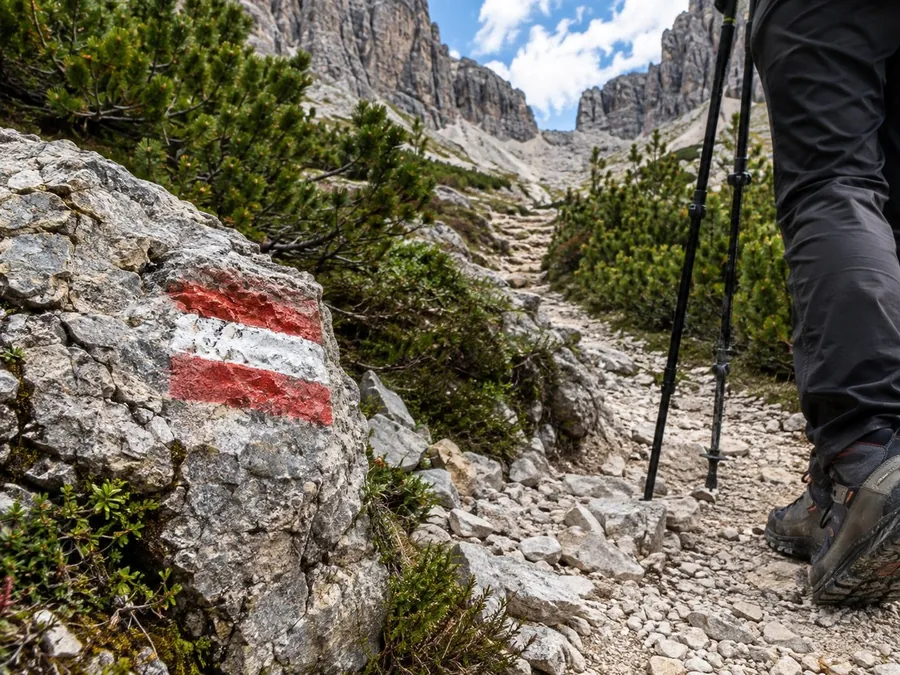
Hiking boots or sturdy trail shoes, as long as the soles grip. Much of the ground is scree and limestone, and limestone is slippery when wet. The rescue services regularly report call-outs to tourists in poor footwear, and every August I pass town trainers on the path up to Forcella Lavaredo. On an E-graded path like the Tre Cime loop, trail shoes with a good sole do the job in dry weather. For the Sorapis loop, a hut trip or anything in June, when snow lingers, I wear boots. What the path grades mean is on how hard the hiking is.
Rain shell and afternoon storms
In July and August the rain shell stays in the pack every day. Thunderstorms build on most afternoons, usually between about 14:00 and 17:00: the day starts clear, cloud builds after noon, and the storm arrives late in the afternoon or evening. Start at 07:00 or 08:00 and be off exposed ground by early afternoon. If a storm catches you, keep off ridges, summits and metal cables, and shelter in a hut rather than under a lone tree. The rest of the safety picture, calmly, is on is it safe to hike.
Sun, water and cash
The UV is high at 2,000 to 3,000 m, and above the treeline there is little shade, so sunglasses, a hat and sunscreen go in the bag even on a cool day.
Carry 1 to 2 litres of water and refill at huts and at marked drinking fountains. Limestone terrain often has few streams; the Sorapis route is an exception, with water at several points according to dolomiti.it.
Carry cash for the rifugi. Some are cash-only, and card terminals fail when the connection drops. Bring a card as well. For navigation, a paper map is a sensible backup to a phone app: Tabacco 1:25,000 is the standard series, and sheet 03 covers Cortina.
What to wear, month by month
- June: snow can linger on north-facing slopes, high passes and gullies into late June, for example on the side paths near Forcella Lavaredo and the gullies of the Sorapis loop. Wear boots, and ask the huts about conditions before you set out.
- July and August: the warmest months, so lighter layers, but the shell and the sun kit every day because of the afternoon storms and the altitude.
- September: the same three layers. Early to mid September is often the best balance of weather and crowds, and most huts are still open until the middle or end of the month.
- October: most huts and many lifts are closed, the days are shorter and colder, and early snow is possible at altitude. Take a warmer insulating layer and plan day hikes with a lower backup.
Which month suits which kind of trip is on the best month to go.
Extra kit for huts and tunnels
For a night in a hut, add a sleeping-bag liner, hut slippers or light shoes (huts often provide slippers), earplugs, a small towel, a headtorch and your alpine-club card if you have one; the rest is on hut to hut in the Dolomites. For the Lagazuoi WWI tunnels you need a helmet and a headtorch, and for EEA routes a via ferrata set. All of it can be rented locally.
A guide’s kit list
The guided Tre Cime hike from Misurina publishes a mandatory kit list, and it is a fair minimum for any day on the classic trails: a backpack, 1 litre of water, trekking shoes, a rain jacket and a phone. The hike itself is about 10 km with about 400 m of climbing, 5 to 6 hours with stops, and the toll road up to Rifugio Auronzo is included. Richard, who walked it in August, wrote “we beat the rainstorm”, which is the case for an early start and a jacket in the bag.
Frequently asked questions
How should I dress for hiking in the Dolomites?
In layers: a base layer, a fleece or light insulated jacket and a waterproof shell, with hiking boots or sturdy trail shoes with grippy soles. Add a hat, sunglasses and sunscreen for the high UV, 1 to 2 litres of water and cash for the huts.
Do I need hiking boots for the Tre Cime loop?
Boots or sturdy trail shoes with a grippy sole are both fine on the loop, a wide, well-marked path graded E with one short steep section up to Forcella Lavaredo. In June, when snow can linger on the side paths, I would wear boots. The route is on the Tre Cime loop page.
How cold is it at the top in summer?
Colder than the valley by about 6 °C per 1,000 m, before wind chill. About 20 °C in Cortina means about 8 °C at Rifugio Lagazuoi, and cols and summits can be close to zero even in July.
What should I pack for a night in a rifugio?
A sleeping-bag liner (required; many huts rent them), hut slippers or light shoes (often provided), earplugs, a small towel, a headtorch, enough cash and your alpine-club card if you have one.