How hard Dolomites hiking is
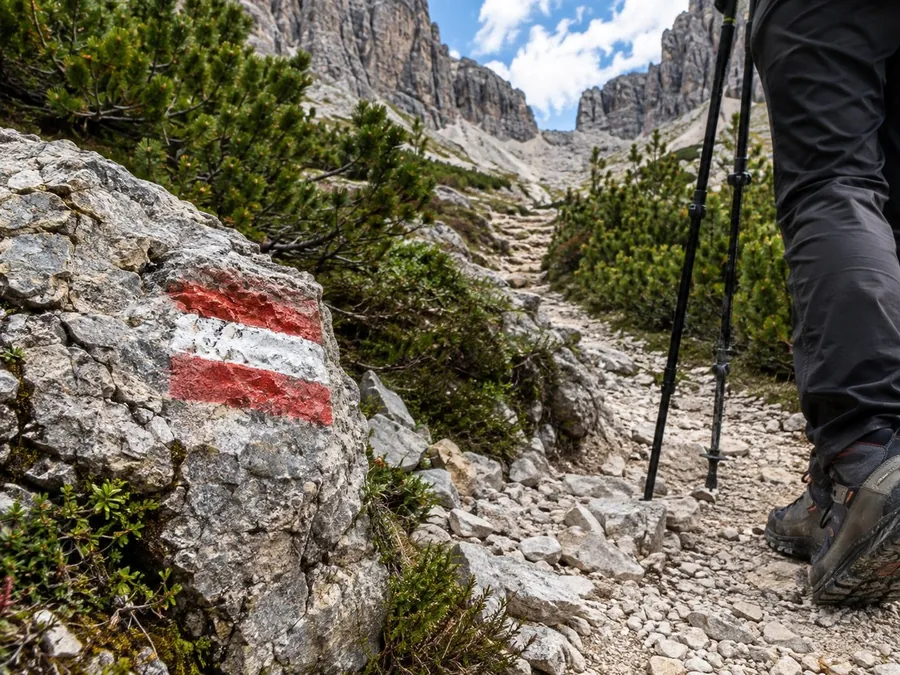
Guided hike or day trip?The famous trails are marked and walked by thousands of people without a guide. What GetYourGuide sells is either a local guide on one of those trails — the Tre Cime loop, Lake Sorapis, the Cinque Torri, the Alpe di Siusi — or a van or coach day from Venice or Lake Garda that shows you lakes and passes with short walks between.
Compare the optionsThe CAI grades, in plain words
Italian maps and route descriptions grade paths with a few letters. These are my summaries of the CAI’s own grade definitions:
- T (turistico): clear tracks and mule paths on gentle slopes, with no route-finding problems. Generally below 2,000 m.
- E (escursionistico): paths over varied ground, with steeper sections, easy rocky steps and exposed bits that are usually protected. Needs some hiking experience and fitness. Most classic Dolomites hikes are E.
- EE (escursionisti esperti): rough or loose ground, exposed traverses, ledges and short easy rock sections. Needs sure feet and mountain experience.
- EEA: via ferratas and equipped paths. Needs a harness, a via ferrata lanyard with an energy absorber, and a helmet.
- EAI: snowshoe routes in winter.
Easy, medium and hard, with examples
Easy. The Lago di Carezza loop (about 30 minutes, T), the track to Fuciade (about 45 minutes each way, T/E, fine for pushchairs), the Lago di Braies circuit (1–1.5 hours, mostly flat), the Cinque Torri loop from the chairlift (1–1.5 hours), the Seceda viewpoint from the cable car, and the meadow walks on the Alpe di Siusi.
Medium. The Tre Cime loop, which is long but not technical; Lago di Sorapis on trail 215, which has one short exposed section with a fixed cable; the Adolf Munkel Weg in Val di Funes (about 9.2 km, about 440 m up); and the Seceda ridge down to Col Raiser. The Tre Cime loop is described step by step on the Tre Cime page.
Harder. The Sorapis loop via Forcella Marcuoira (EE, about 4 h 45 min), the Passo Giau, Nuvolau and Cinque Torri loop (about 5.5 hours and 950 m, with cabled options on Ra Gusela), Col di Lana (3–4.5 hours up and 780 m or more), and the Lagazuoi tunnels, which are for sure-footed walkers with a helmet and a head torch.
Can a beginner hike the Dolomites?
Yes. A beginner can walk every easy hike above and the Tre Cime loop. Sorapis on trail 215 suits a confident beginner who is fine with a short cabled ledge. The guided Tre Cime listing calls the loop “suitable for beginners”, and Mauro, on the guided Cinque Torri hike, wrote: “Also accessible for those like me who are not fit”. Claire liked that her Tre Cime guide “matches the pace of the group”.
What catches beginners out is rarely the path. It is the length of the day, the altitude, the afternoon weather, and limestone and scree that turn slippery when wet. A guide deals with the pace and the weather call for you; when that is worth paying for is on guided hikes.
How hard is it to climb the Dolomites?
Much harder, and it is a different activity. The summits of the Tre Cime are rock climbs, and the highest peak in the range, the Marmolada, reaches 3,343 m at Punta Penia. Via ferratas (grade EEA) need a harness, a via ferrata set and a helmet, all of which you can rent in the resorts. First-timers should hire a certified mountain guide, a guida alpina. For multi-day routes, the Alta Via 1 needs no via ferrata kit on its main line; the Alta Via 2 has exposed ridges, scree and several cabled or via ferrata sections and is for experienced hikers with a head for heights.
Altitude
Most popular hikes sit between 2,000 and 2,800 m. The CDC says altitude illness can occur above about 2,450 m, but the risk is tied mainly to how high you sleep and how fast you go up. Day hikers who sleep in the valley rarely have problems, although some feel breathless or get a mild headache above about 2,500 m, and most rifugi sleep below 2,800 m. The rest of the safety picture is on is hiking the Dolomites safe.
The fitness you need
For the classic loops: 3–5 hours on your feet with 300–600 m of climbing. For the Alta Via 1: several days in a row of 5–7 hours with repeated climbs of 800–1,000 m or more. My test for friends is simple. If you can walk four hours at home with a couple of long hills and still enjoy dinner, you can walk the Tre Cime. Good shoes matter more than fitness on limestone; see what to wear.
If you would rather have someone set the pace on your first day up high, the guided Tre Cime loop from Misurina is the gentlest way in: 10 km, about 400 m of climbing, toll road included, rated 5.0 from 26 reviews.
Frequently asked questions
Is hiking in the Dolomites difficult?
Not on the classic trails. Most are CAI grade E: marked paths with some steep sections, 3–5 hours and 300–600 m of climbing. Harder EE routes and via ferratas exist, but you have to go looking for them.
Can a beginner hike the Dolomites?
Yes. Lake circuits like Braies, lift-assisted walks like Seceda and the Cinque Torri, and the Tre Cime loop all suit beginners who can walk a few hours. Start with one of those on the best hikes list.
Is the Dolomites hard for a beginner?
The paths are not. The length of the day, the altitude and the afternoon weather are what tire beginners. Start early, pick a grade E or easier route, and wear shoes with a grippy sole.
How hard is it to climb the Dolomites?
The summits are rock climbs, and via ferratas need a harness, a lanyard with an energy absorber and a helmet. First-timers should go with a certified mountain guide. Walking round the peaks is a different, much easier thing.
Is the Alta Via 1 difficult?
It is the least technical of the high routes, with no via ferrata kit needed on the main line, but it asks for several days of 5–7 hours with big climbs. More on hut to hut.